The Orthodox Parish of St Aidan & St Chad, Nottingham (EP)

The Meeting of the Lord in the Temple                  2 February

2/2/2020

                   
                    Now lettest Thou Thy servant depart in peace,
                    according to Thy Word,
                    for mine eyes have seen Thy salvation
                    which Thou hast prepared before the face of all peoples,
                    a Light to enlighten the gentiles,
                    and the glory of Thy people Israel.
                                                              (The Canticle of Simeon, Luke 9:29-32)

The first words of the canticle, pronounced by Simeon when he sees the Child, are an exclamation of joy at his approaching death. It is an answer to the promise made by the Holy Spirit to the old man: he is not to die before seeing the Christ of the Lord.

In one of the Psalms of the Ascent which we sing during Vespers in Lent, the psalmist sings:
                                                                                           (click below to read more:)      

               “I wait for the Lord, my soul waits,
                and in His word I hope;
                my soul waits for the Lord
                more than the watchman for the morning,
                more than the watchman for the morning.
                O Israel, hope in the Lord.”
                                                                      (Ps 129:5-7)

Simeon is the last “watcher” (vigilant) of Israel (remember also Habakuk, who watches by night, in the 4th Ode of the Canon): he looks out for the dawn, and he finally sees the day begin to break and recognises the light of the “Sun of Righteousness.”

The Canticle of Simeon, known as Nunc Dimittis (Now lettest Thou, Lat.) is one of the three New Testament canticles, and it is recited at the end of each Vespers.
At Vespers we experience the long period of expectation for Christ in the Old Testament. The service begins with Psalm 103 – an account of creation. Then we read other psalms and scriptural passages indicating Israel's hope. This expectation is fulfilled in the encounter between the Old and New Covenants, an encounter realised in the person of Christ. As the light of evening comes and the day draws to an end, we contemplate a different light, the joyful Light, which Simeon meets in the Temple: 
                          “O joyful light, Thou Jesus Christ!...”

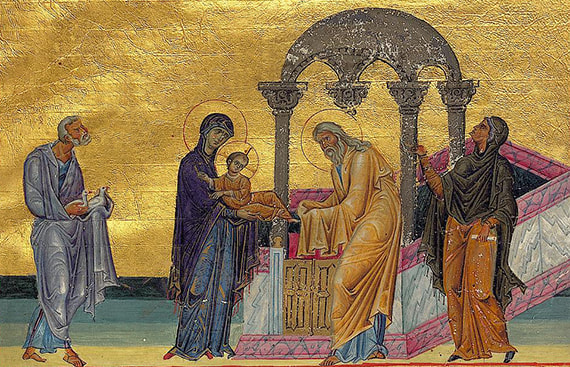
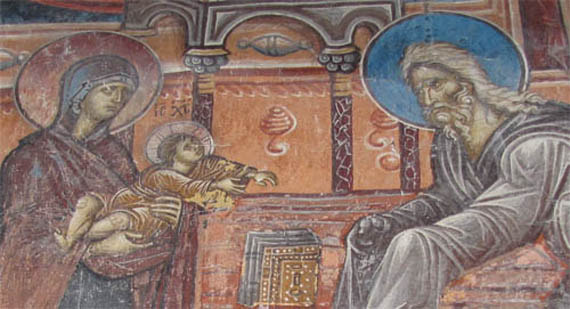
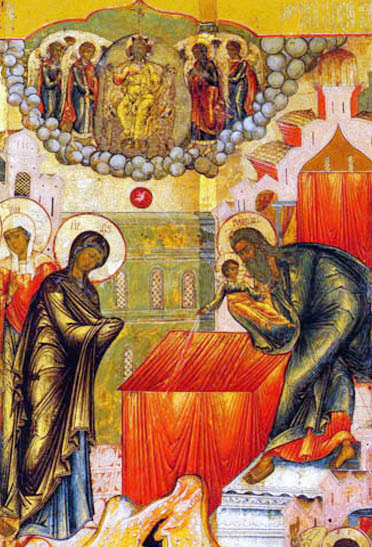
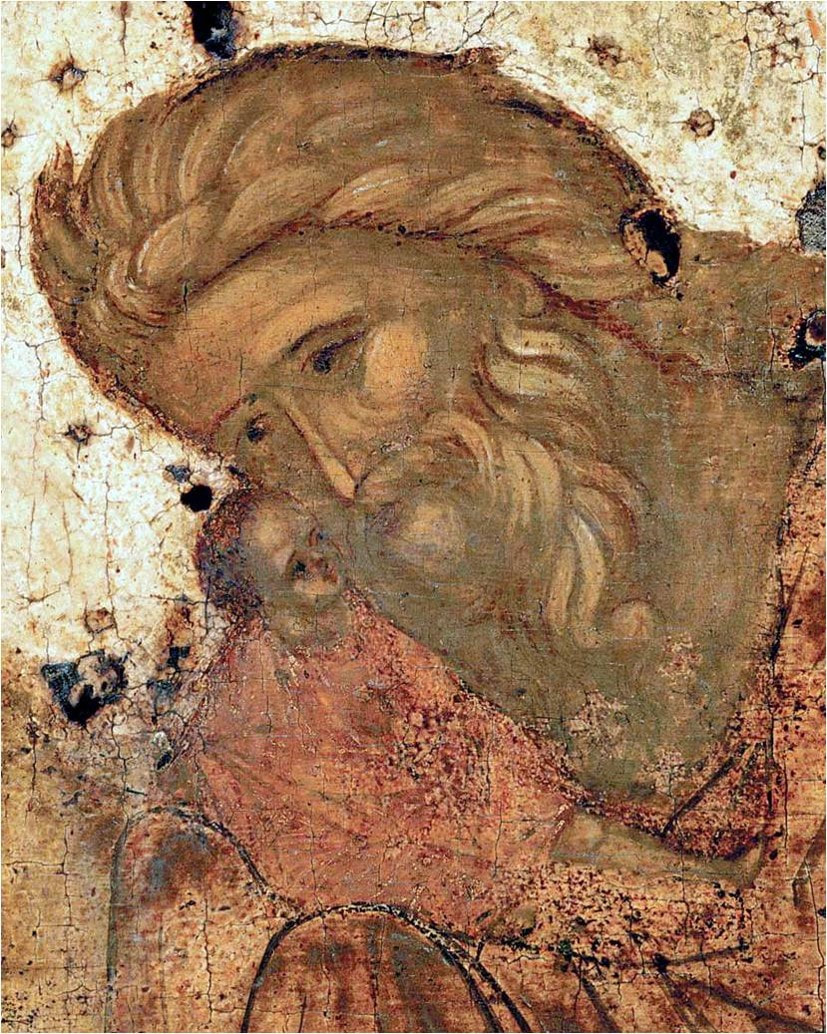
Although we see the Elder Simeon opening his arms to receive the Divine Child, it is actually the Child, Who sustains all creation, Who
                          “stretches out His hand to Adam” (Canon, Ode 3, troparion)

At the Festal Vespers of the Encounter in the Temple, we hear three Old Testament readings. One of them is

Isaiah's vision of God (Isaiah 6:1-12)

Simeon, like Moses on Sinai, meets God face to face. But Moses saw God in the cloud and had to cover his face, so bright was the light of God. Simeon, however, took God in his arms. It seems that the rule to see God in face has been lifted after the birth of Christ. Has man become more worthy to see God? Is he pure enough to meet Him? Humanity in the New Testament is neither more worthy nor more pure than in the Old Testament, but it receives purification through Christ Himself, and Christ has the power to remove all stains. This is the reason why, at this Feast of the Encounter, the Church lets us hear the passage from Isaiah describing his vision in the temple (Is. 6:1-12). When Isaiah saw the Lord seated on a raised throne, and contemplated His glory, when he heard the Thrice-Holy song of the angels, he exclaimed: “Woe is me! For I am lost; for I am a man of unclean lips... For my eyes have seen the King, the Lord of hosts!” (Is.6:5). A seraphim was sent to him bearing a burning coal taken from the altar with tongs in order to purify the lips of the prophet. After distributing Holy Communion to the faithful, the priest pronounces these words: “Behold, this has touched your lips and your guilt has been taken away and your sin has been forgiven."

Another Old Testament reading is about

The burnt offering (Leviticus 12):

‘If a woman conceived and bore a male child, (6)When the days of her purification are fulfilled, she is to bring to the priest a lamb of the first year as a whole burnt offering, and a young pigeon or a turtledove as a sin offering, to the door of the tabernacle of testimony. (8) But if she is unable to afford a lamb, she may bring two turtledoves or two young pigeons—one as a whole burnt offering and the other as a sin offering. So the priest shall make atonement for her, and she will be clean.’

On the icon we see the righteous Joseph carrying two turtledoves. Yet, the spotless Virgin needs no purification. We also see there is no lamb.
The absence of a lamb in the evangelist Luke's story and on the icon is no accident either, and it is not necessarily because of their poverty that “a victim is not brought”. Mary extends her arms, which are covered with a cloth. She offers the Child and gives Him to the Elder, who receives the Infant over the sacrificial altar. Jesus is the spotless Victim, pure and innocent, He is the “Lamb of God” offered as a sacrifice:
                              “The pure Dove, the Ewe without blemish,
                               brings the Lamb and Shepherd into the temple.”
                                                                                               (Canon, Ode 9)

Just as Abel was immolated in place of his lamb, just as Isaac was offered in sacrifice by his father, as the suffering servant of Isaiah allows himself to be led to the slaughter, a submissive and defenceless lamb, so today Jesus is brought to the Temple and received by the priest at the altar – a prophetic vision of his death on the Cross.

Christ is also this living Coal which purifies, and the Virgin Mary is

             “the mystic tongs who hast conceived in thy womb Christ the live Coal."
                                                                                                             (Canon, Ode 9, troparion).

              “Christ once appeared to the divine Isaiah as a burning coal held by tongs.
              Now He is given to the elder by the hands of the Mother of God.”
                                                                                                             (Aposticha, tone 2)

The Temple assumes its eternal dimension before the Creator, it becomes the true meeting place, a place of Encounter between God and His people! The altar on which the Lord is offered is the throne of God, that of the heavenly Jerusalem:

               “And between the throne and the four living creatures and
                among the elders, I saw a Lamb standing, as though it had been slain...”
                                                                                                                           (Rev. 5:6)

(excerpts from The Incarnate God – A Festal Catechesis)

                                               The Meeting of the Lord

                   (from the Festal sermon by Fr Alexander Schmemann)

“How striking and beautiful an image, the old man holding the Child in his arms, and how strange are his words: “For my eyes have seen Thy salvation . . .” Pondering these words we begin to appreciate the depth of this event and its relationship to us, to me, to our faith. Is anything in the world more joyful than an encounter, a meeting with someone you love? Truly, to live is to await, to look forward to the encounter. Isn’t Simeon’s transcendent and beautiful anticipation a symbol of this? Isn’t his long life a symbol of expectation, this elderly man who spends his whole life waiting for the Light which illumines all and the Joy which fills everything with itself? And how unexpected, how unspeakably good that the long awaited light and joy comes to the elderly Simeon through a child! Imagine the old man’s trembling hands as he takes in his arms the forty-day-old Infant so tenderly and carefully, his eyes gazing on the tiny being and filling with an outpouring of praise: “Now, You may let me depart in peace for I have seen, I have held in my arms, I have embraced the very Meaning of life.” Simeon waited. He waited his entire long life, and surely this means he pondered, he prayed, he deepened as he waited so that in the end his whole life was one continuous “eve” of a joyful meeting.

Isn’t it time that we ask ourselves: what am I waiting for? What does my heart keep reminding me about more and more insistently? Is this life of mine gradually being transformed into anticipation, as I look forward to encountering the essential? These are the questions the Meeting poses. Here, in this feast, human life is revealed as the surpassing beauty of a maturing soul, increasingly liberated, deepened and cleansed of all that is petty, meaningless, and incidental. Even ageing and demise, the earthly destiny we all share, are so simply and convincingly shown here to be growth and ascent toward that one moment when with all my heart, in the fullness of thanksgiving, I say: “let me now depart.” I have seen the light which permeates the world. I have seen the Child who brings the world so much divine love and who gives Himself to me. Nothing is feared, nothing is unknown, all is now peace, thanksgiving, and love. This is what the Meeting of the Lord brings. It celebrates the soul meeting Love, meeting the One who gave me life and gave me strength to transfigure it into anticipation.”

                                                             compiled and edited by Vera Davidova-Pote

Mid-pentecost

22/5/2019

When the Jews reproach Jesus for healing the paralytic on the Sabbath, Jesus answers: “My Father is working still and I am working” (Jn 5:17). God is master of the Sabbath. His rest after creation does not mean that He turns away from His work, nor that He leaves creation without direction. Quite the contrary, God’s powerful hand sustains the created world and ceaselessly supports it above the void. When He heals the sick man on the Sabbath, Jesus declares Himself to be the Son of God, sent by the Father to save humanity which is on the road to perdition, which is adrift without the permanent support of the Master and Creator.

According to the Church, the meaning of the feast of Mid-Pentecost is the link between the Father, the Son and Holy Spirit. On this Wednesday of the fourth week of Pascha (exactly in the middle between Pascha and Pentecost), we celebrate Christ the Mediator. He is sent by the Father, and He promises us the Holy Spirit.

"Today is the celebration of Mid-Pentecost.
On one side, Pascha illuminate with its divine splendour,
on the other side is the radiant grace of the Paraklete."*
(The Canon, Tone 4, Ode 6)

The gospel read at Mid-Pentecost (Jn 7:14-30) begins with the following words: “About the middle of the feast Jesus went up into the temple and taught.” The feast is the Feast of Booths, celebrated by the Jews in Sukkoth (September-October). It consists of the blessing of the fall harvest and thanksgiving to God for protecting the people during the stay in the desert. On the eighth day of the festival, special prayers are made asking for rain. It is on this day, the last day of the feast, that Jesus stood and raised his voice: “If any one thirst, let him come to me and drink. He who believes in Me!” For, as John specifies, “Out of his heart shall flow rivers of living water” (Jn 7:37-38). Living water is the sign of Pentecost. This Wednesday feast falls just a few days before the Sunday of the Samaritan Woman. Now we live in the expectation of the Holy Spirit Our thirst for God quickens our senses and gives us the impulse to accept God’s gift:

“As a hart longs for flowing streams,
so longs my soul for you, O God.
My soul thirsts for God, for the living God.
When shall I come and behold the face of God!”
(Ps 41:1-2)

The Icon of Mid-Pentecost
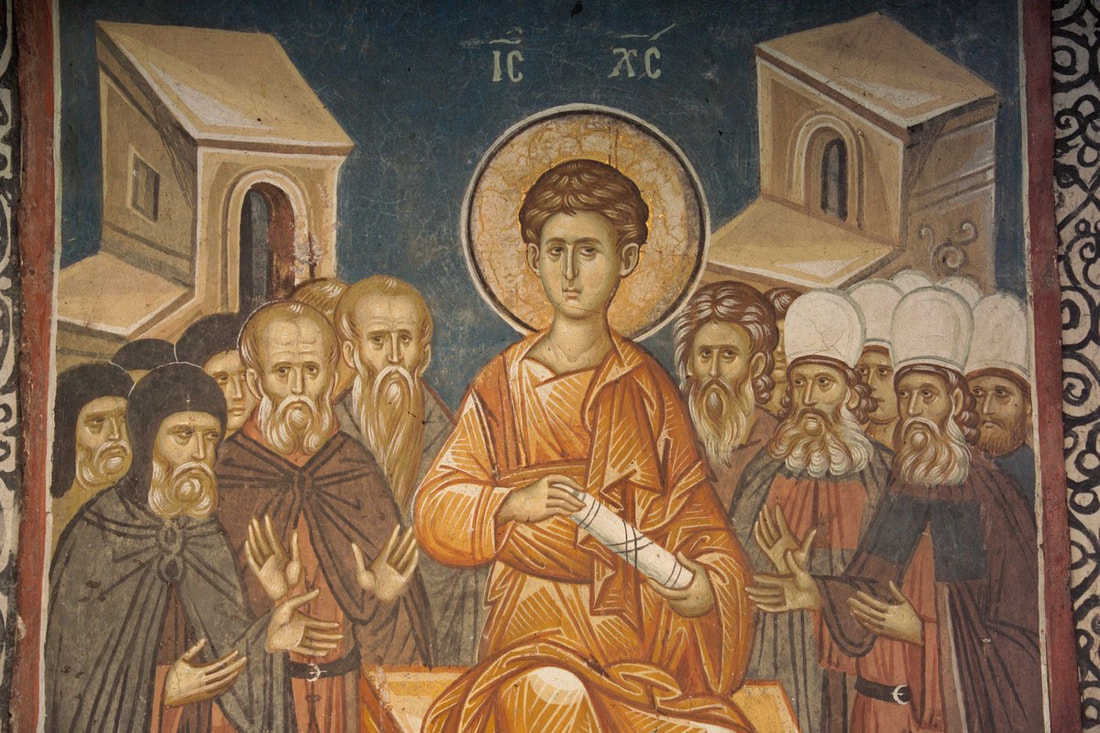
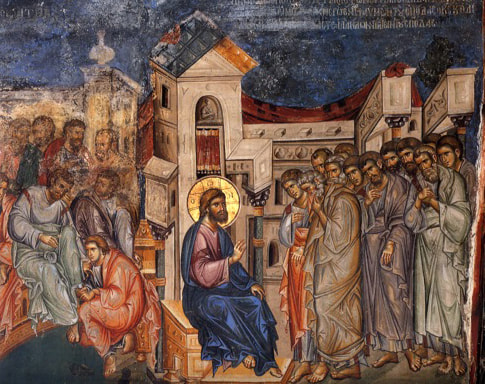
The iconography adopted by the Church to illustrate Mid-Pentecost shows us Jesus teaching in the Temple, just as in the gospel. Jesus is sitting at the centre of the Jewish scholars and wise men. These express their amazement at his knowledge: “How is it that this man has learning, when he has never studied?” (Jn 7:15). In answer to this question, Jesus speaks of his connection to the Father, of His divine origin.

Most often, the icons of Mid-Pentecost represent Jesus’ first encounter in the Temple with the doctors of the Law – this is the episode described by Luke, when Jesus was twelve years old (Lk 2:41-50). “Did you not know that I must be in my Father’s house?” - He says to his worried parents, thus openly declaring that He is the Son of God and the He must carry out His mission. On that day, Jesus declares His independence from Joseph and Mary; He disobeys them and escapes their tutelage. He tells them about His unique link with God the Father. He accepts filial obedience to the end, and obedience which will lead Him all the way to the cross. “Not My will, but Yours, be done!” (Lk 22:42). Divine Wisdom is revealed to the doctors of the Law who admire the wisdom of the child, revealing Jesus as the Child-Emmanuel announced by the prophets (Is 7:14). The authority of His teaching is already confirmed during His infancy, for “He is before all things,” He precedes creation (Col 1:17 and Prov 8:22-30), “He is begotten, not made, of one essence with the Father” (the Creed). He is “the Wisdom, the Word, and the Power of God” (Matins at Pascha).

The Temple, Site of the Teaching
From His infancy to His passion, Jesus teaches in the Temple, the place of divine presence. In this we can recognise the unity of His teaching and the fulfilment of the Old Covenant in His Person. For He is the “Temple not made with human hands” (Mk 14:58). The hour is coming when all the faithful will be assembled in the Body of Christ.

The Master and Saviour never speaks of Himself. He always refers to the heavenly Father, in this way avoiding the egocentrism which haunts so many so-called masters who hold away the weak-minded. These seek only their own glory, and not the revelation of God to the world. The revelation of the Name of the Father appears in all of Christ’s teaching.

* the Comforter

(The Incarnate God - The Feasts and the Life of Jesus Christ and Mary, Vol. II,
SVS Press, 1995)

                                                                                      compiled by Vera Davidova-Pote

Father David's Sermon for Palm Sunday 2019

23/4/2019

Fr David’s Sermon for Palm Sunday, 2019

Today we are challenged at the point when we move from Great Lent, now completed and into Passion Week about to begin. The challenge is this: Will we have become changed on Bright Monday, the day after Pascha compared with how we were on Clean Monday at the beginning of the Fast. Yes, we have been encouraged to abstain from various foods, to spend more time in prayer and church attendance and almsgiving, but these are only aids to something much more fundamental. The aim of Great Lent is to be changed into the likeness of Christ. The aim of the Christian life is to be transformed into the likeness of Christ.

In the Liturgy of St Basil we are reminded that Christ emptied Himself, taking the form of a servant, becoming man in order to condemn sin in his flesh, that those who are dying in Adam might be made alive in Christ. Then there is another challenge. Yesterday we remembered the miraculous raising from the dead of Lazarus. He had been lying in the tomb dead for four days. Jesus went to the tomb and commanded that the stone at the entrance be removed and then he shouted:
“Lazarus, come forth, Lazarus come out!” Lazarus may well have thought, in response: “But it is comfortable here, I am enjoying a good sleep after my hard life!” But our Lord insisted: “Come out, I have more for you in this life!”

This call also applies to us - we are to come out to be made alive in Christ, we have to come out of our comfort zone. This challenge was also there for the crowd which had gathered in Bethany to meet this extraordinary Teacher who had brought about this miracle. When they saw Him mounted on an ass, a donkey, they joined in shouting: “Hosanna to the son of David, Blessed is He that comes in the name of the Lord.” At last, they thought, here is one who can liberate us, let us support this new life in Christ. The leaders of the nation, however, had other thoughts. They saw the challenge of Jesus as a threat. Who was this usurper, troublemaker who might upset the comfortable relationship they had with the Roman Authorities. Better to be dying in Adam rather than be influenced by this man. And so Jesus was condemned to death to be out of the way. The crowd who had hoped for revolution and change a few days earlier was now unsure and perhaps persuaded to be quiet. The one they had hailed as Son of David was now at the mercy of their leaders, perhaps they had information that the crowd did not have, the leaders could not have demanded such a cruel execution without reason, especially one that was reserved for slaves, non citizens, criminals. Now the tune was changed, better be with the Leaders and cry, at their instigation: “Crucify!” Better to be content to be dying in Adam rather than be made alive in Christ, this criminal.

Even the Apostles and disciples must have felt uncertainty and despair, though some would have recalled that Jesus had said that he would rise again. But how could this be, the body tortured, wracked and distorted by Crucifixion was very different from the body of Lazarus who had experienced a normal death. For three days they were in despair until all uncertainty was swept away as they found themselves indeed being made alive in Christ, following His Resurrection.

Well, all of us will have some thoughts that we have not kept Great Lent as we should, but St John Chrysostom in his Paschal homily reassures us that the table is laid, the feast is ready and we are all invited, those of us who have kept the Fast from the beginning and those of us who are coming at the “eleventh hour”. In Passion Week, for all of us, the Church provides us a great opportunity, even in the eleventh hour! - on Wednesday there is the Healing Service; on Thursday - the Liturgy of the Last Supper in the morning; and in the evening we are invited to stand with our Lord in His Passion as we read the Twelve Passion Gospels. Then, on Holy and Great Friday, we are present at the laying of Christ in the Tomb during Vespers. Saturday morning reminds us that Christ’s first act was to reveal His Resurrection to those in Hades, the resting place of souls and in that joy which Adam and Eve experiences, all our own departed relatives will rejoice as well and we can stand with them as the first Gospel of the Resurrection is proclaimed. All this before Saturday evening, the full and joyful celebration of Christ’s Glorious Resurrection.

The whole reason for Great Lent has been to realise the whole purpose of life: to be changed into the likeness of Christ and to be able to enter with joy into His Glorious Resurrection, no longer dying in Adam, but being made alive in Christ!

Amen.

Letter from the archbishop

30/10/2018

Ecumenical Patriarchate Archdiocese of Russian Orthodox Churches in Western Europe
Communiqué from the Archbishop's Office:

Dear Brothers and Sisters,

we inform you that our Archdiocese-Exarchate under the jurisdiction of the Ecumenical Patriarchate is in full communion with the whole Orthodox Church. Indeed, the Ecumenical Patriarchate did not break communion with the Patriarchate of Moscow and continues to commemorate it according to the order of the diptychs.

All the Orthodox faithful can therefore participate fully in the liturgical and sacramental life of our parishes.

We invite all the priests, deacons, monks, nuns and faithful of our Archdiocese- Exarchate to pray for the unity of the Church, and we ask the priests and deacons to include and pronounce audibly at the end of the litany of fervent supplication during the liturgy, the following prayers inspired by Archimandrite Sophrony.

Prayer for the unity of the Church:

Lord Jesus Christ, Lamb of God, who takes away the sin of the world, give us the strength to love as Thou has commanded us.
As Thou has said to thy disciples, "Love one another, as I have loved you,” give us the grace and wisdom to fulfil this commandment every day.
Through Thy Holy Spirit, give us the courage to humble ourselves in front of others, understanding that the one who loves more also humbles himself more.
Teach us to pray for each other and to bear each other's burdens patiently; by the bond of an unwavering love unite us around our patriarchs and bishops like the docile sheep of a single flock gather around their shepherds whom they love.
Grant us to see in each of our brothers and in each of our sisters the image of Thine ineffable glory, and never forget that our brothers and sisters are part of our own life.
Place us under the protection of Thy Most Holy Mother, Thy Forerunner John the Baptist and all our venerable Doctors, Fathers, Mothers and Confessors of the Faith. Amen.

HOMILY: Sunday of Paralysed Man (John 5:1b-15) 2018

29/4/2018

Sunday of Paralysed Man (John 5:1b-15) 2018
In the Name of the Father, and of the Son, … Amen
As some of you will know, I was, for a number of years, a Samaritan volunteer. As a Samaritan you soon learn the importance of exploring ‘Feelings’. And, as a man, you soon learn that ‘Feelings’ are not the sort of thing we males like to talk about! Our feelings reflect the way we view and experience the situations in which we find ourselves.
Now consider how the paralysed man in today’s gospel reading might have felt. We do not know the biological origin of his paralysis; only that he had suffered infirmity for 38 years. We know also that he had been lain a short distance from healing. All that was needed was for him to enter the pool at the moment that the waters were stirred. But, alas he did not have the strength to get himself into the pool.
And no-one, not one single person in all the time he had been there, had shown him compassion. No-one had offered to help him. Others had rushed into the pool when the waters were stirred. Some under there own steam, others helped by friends, family and those who loved them. But this man had no-one. No-one cast a glance at him, no-one cared, no-one showed him compassion. Consider how he might have felt! Consider the feelings of loneliness, the feelings of total isolation that he might have experienced. How many times might he have asked, why me? What have I done to deserve this? Is God punishing me?
How might you have felt if this was your life!
Not all paralysis is as obvious as this man's! We are surrounded by people who are paralysed. Sometimes physical, but more often emotional or spiritual paralysis.
Anxiety can be paralyzing. Often, living with anxiety is like living without the ability to live for yourself.
We all have moments of procrastination, but for some people procrastination is crippling, paralysing! The muscles work, the mind works, but you are completely unable to take any type of constructive action. Like a zombie, you walk around in your house,  get distracted, spend endless hours on Facebook, it can take you hours to finally get yourself to take a shower or go for a walk; you can respond to other people’s demands on you but, when it comes  to following your own directives or desires, your body no longer responds.

Spiritual Paralysis; We may have been spared physical paralysis, we may have been spared emotional paralysis, but none of us can escape spiritual paralysis. At its root, Spiritual paralysis is caused by sin which causes damage to the nous (soul), the mind, the heart and even the body.
How do we know if we have spiritual paralysis? What are the symptoms?

Well, Spiritual paralysis can manifest itself in many ways but perhaps the most common is wanting to do the right thing, for example, go to church, pray, help others etc. but then not having or taking the time, making excuses, or
becoming distracted with interruptions and other priorities. Trying to do the right thing; but then messing it up
for example, despite best efforts one consistently arrives late for church Praying selfishly for the wrong things, hurting instead of helping others. Or, worse yet, no longer having the desire to do the right thing.  It may be that we are having difficulty controlling our thoughts or feelings. Almost as though someone else has taken control. These are all symptoms of spiritual paralysis.

As I said earlier, we are surrounded by those suffering paralyses. In fact, this world can appear paralytic – Spiritually and morally paralysed, not knowing how to overcome the problems that it has invented for itself!

In our gospel reading Jesus shows us the intimate connection between the soul and the body. Jesus heals the man, not only physically but he also heals him spiritually by forgiving his sins. He, who overcame death in his own body, has power over all human flesh. Our Lord can heal the paralysed man because he himself can rise from the dead.
However, something is needed for healing to take place ...
v6: He said to him, “Do you want to be made well?”
Before healing can take place, there needs to be a desire to be healed. Our Lord does not heal those who do not want to be healed. Do those countries that wish to engage in conflict and want to slaughter other peoples, really want healing? Do they really want to be healed of their passion for bloodletting, hatred and terrorism? Do corrupt politicians really want to be healed of their greed and need for power? Do those criminals who persistently steal want to be healed of their desire for material riches?

And what about us! Do we want to be healed of our sinfulness and passions? Do we really want to be less indifferent to God and is Church? Do we really want to be healed of our lack of faith?

I once heard a story of a missionary in India who was appalled to see chickens, for sale at a market, that had been tied to wooden stakes. The chickens could only walk as far as their tethers would allow. And so, as they waited to be sold, the chickens walked around and around the stakes creating furrows in the ground.

The missionary felt that he needed to do something to ease the suffering of the chickens and so, he bought them all.
Then having paid, He instructed the vendor to cut all the strings and free the chickens. And so, the strings were cut, and the chickens were, for the first time in their lives, free!

And guess what they did!

They continued to walk around the stakes, walking in the same furrows. The chickens continued to do what they had always done!

Like those chickens, we too have been set free. Christ gives us freedom. But we need to take advantage of that freedom. The freedom Christ offers brings healing and so we can be healed and freed from our paralysis. But, only if that is what we want. We need to “take up our bed and walk”. Or, like the chickens, we can continue to do what we have always done; The choice is ours!

Through the prayers of all our Holy Fathers …