The Orthodox Parish of St Aidan & St Chad, Nottingham (EP)

Holy Pentecost 2020 (Covid-19)

6/6/2020

So, what would you prefer; would you rather lose £10 or find £10?
I think it is safe to say that we all experience ‘loss aversion’ that is our tendency to prefer avoiding losses to acquiring equivalent gains. Loss and giving up can be difficult concepts for us to accept, since both are often equated to failure and it has been suggested that losses are twice as powerful, psychologically, as gains. For many, if not all of us, loss and giving up have been a dominant feature of this pandemic period.

There is however a different dimension to loss a giving up. I refer to the spiritual life. Let me take you back to the start of our life with Covid-19 (Coronavirus). Fr David shared his thoughts and the thoughts of Elder Zacharias of Essex with regard to ‘Hesychia’. This is a state when there is an inner stillness and one abides alone in spirit with God; attained only through loss and giving up!

There is a story of a Japanese sage who served tea to an enquiring professor. The sage poured his visitor’s cup full, and then kept on pouring. The professor watched the overflow until he no longer could restrain himself. “It is overfull. No more will go in!”, he cried. “Like this cup,” the sage replied, “you are full of your own opinions and speculations. How can I show you anything unless you first empty your cup?”
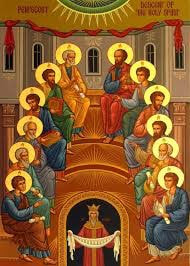
This Sunday is 8th Sunday of Pascha, Holy Pentecost and is followed by The Day of the Holy Spirit on Monday.  Pentecost Sunday commemorates the coming of the Holy Spirit in the form of flames to the Apostles, as recorded in the New Testament in Acts, 2. The Holy Spirit allowed the apostles to speak in other languages through 'tongues of fire', and they started preaching the Gospel to the Jews who come to Jerusalem for the feast of Shavuot (Pentecost),  a festival that celebrates the giving of the Ten Commandments to Moses on Mount Sinai. We recognise this day as the birth of the Church for two reasons. Firstly, the descent of the Holy Spirit completed the Trinity - the Father, the Son and the Holy Spirit - the basis of Christian theology. Secondly, it was the first time that the Apostles had preached to the masses.
And so, Pentecost is a celebration. However, Henri Nouwen reminds us that …
"We cannot celebrate Christmas when there is nothing new born here and now; we cannot celebrate Easter when no new life becomes visible; we cannot celebrate Pentecost when there is no Spirit whatsoever to celebrate. Celebration is the recognition that something is there and needs to be made visible so that we can all say yes to it.’

This is not a time of loss, of giving up or of emptying, but rather This is a time to celebrate the coming and receiving of the Holy spirit.  At baptism/Chrismation we each had the name of the Holy Trinity invoked over us.  We were washed clean of sin.  And coming out of the baptismal font, for those of us who were baptized in the Orthodox Church, we immediately received the sacrament of Chrismation, we received the Holy Spirit. The Holy Spirit dwells in each of us.

In the Orthodox Church this is the only prayer, among all the prayers of the Church, that is ad- dressed to the Holy Spirit and for the last 50 days we have ‘given up’ saying our introductory Prayer to The Holy Spirit 
 “O Heavenly King, Comforter, Spirit of Truth, who art everywhere and fillest all things, Treasury of Blessings and Giver of Life: come and abide in us, cleanse us from all impurity and of thy goodness, save our souls.”
The prayer is so important that we should preface all of our prayers with it! But arguably it is just as important that we remember and understand what it is we are saying and why.  I therefore invite you, for the next few days to look at the Prayer to the Holy Spirit phrase by phrase; to perhaps use each phrase as a daily meditation.


Meditations on the Prayer to the Holy Spirit.
O Heavenly King,

  • The Holy Spirit is truly God, just like the Father and the Son.
  • What’s more, this is a reminder that we have a King; we are His subjects, and it is our goal to bring our hearts under His holy reign.

Comforter,

  • In Greek, this word is Paraclete, which is not only one who brings comfort, but also one who makes us stronger, who encourages us and who is our helper and would advocate for us and defend us.
  • The Holy Spirit is actively working toward our salvation, encouraging our good efforts and also making efforts on our behalf.

Spirit of Truth,

  • When Jesus dies on the Cross, His disciples don’t really understand what is happening. They are still looking for the new King of Israel — in fact, even after His resurrection, they continue to ask if He is about to take the throne of Israel now.
  • They do not yet understand that the Kingdom of God is not of this earth and is in fact much larger and more revolutionary than an earthly government could ever be.
  • Jesus says that the disciples are ‘not ready to bear’ all of this information yet, but when the Spirit of Truth comes, He will guide them to understanding.
  • The Holy Spirit is the Spirit of Truth, because He speaks to our heart and reveals the Truth of the Gospel and the Truth of God’s love for us and of the whole plan for our salvation and deification.

Who art everywhere present and Who fillest all things,

  • God is everywhere — we cannot hide from Him; there is nowhere we can go to be away form Him.
  • The Holy Spirit is everywhere present, and while He cannot be contained, He is present in all things.
  • Of course, when we are chrismated we seal the Holy Spirit inside of people, and when we bless our food or when a priest blesses holy water or an icon etc we are asking the Holy Spirit to come down into this thing.
  • The Holy Spirit can and does fill up all things — even the humblest form of matter can be filled with the Holy Spirit.
  • God truly loves His creation.

Treasury of Blessings

  • All good things come from God — and so we are not surprised to find that the Holy Spirit is a treasury of good things.
  • In his letter to Galatians, St. Paul lists the specific gifts of the Holy Spirit: “But the fruit of the Spirit is: love, joy, peace, long-suffering, kindness, goodness, faithfulness, gentleness, self-control.” (Gal. 5: 22-23)
  • If we hope to have any of these things, we should look to the Holy Spirit, the treasury of blessings.

and Giver of Life,

  • The Holy Spirit is the giver of life everlasting to all who place their hope in the Son of God.
  • The Holy Spirit is the One who holds everything that exists together; He is truly the giver of all life.
  • It is the presence of the Holy Spirit that makes life possible, that sustains us and our whole Cosmos.
  • This planet continues to rotate and to orbit around the sun, this galaxy, this universe, the multi-verse, all of it, holds together because of the Holy Spirit.

come and abide in us, —

  • After thinking of the Holy Spirit in this cosmic way, how amazing to come down to the very personal level and to think that at our chrismation, we were given the seal of the Holy Spirit.
  • The Holy Spirit is within us, and several times a day, we pray that the Spirit come and abide in us. We don’t wish to be just visited by the Spirit on occasion, but to attract the Spirit to stay with us, at work in the workshop of our hearts all of the time.
  • The Holy Spirit can do that — He can stay with us, and simply live in our hearts, always helping us.

 
and cleanse us from all impurity —

  • The work of the Holy Spirit is to cleanse our hearts, to free us from the sins and passions that bind us.

and save our souls, —

  • By abiding in us and cleansing us, the Holy Spirit saves our souls, bringing them to eternal life.

O Good One. —

  • Finally, we affirm the goodness of the Holy Spirit and of God, just as God affirmed the goodness of creation every day (And He saw that it was good.)
  •  God is good, and He is the source of all that is good, so we conclude, O Good One.

 
Fr Julian
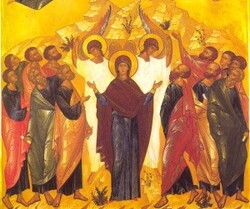
The Icon of the Feast of the Ascension

28/5/2020

Forty days after Christ’s resurrection, He was taken up into the Heavens before the disciples, and so forty days after Pascha, falls the Feast of the Ascension.
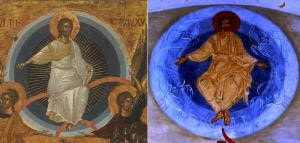
The icon for the feast shows the events as described in the Book of Acts, though as with all Holy Icons there is more revealed than just a straight retelling of the story in pictures.

Based on the accounts written by St Luke in his Gospel (Luke 24:36-53) and the Book of Acts (Acts 1:1-12), the icon of the Ascension is correspondingly ancient. One of the earliest surviving images of the Ascension, a full-page illustration from the 6th century Rabbula Gospels, is remarkably similar to all subsequent icons, with precious few variations. Icons from St Catherine’s monastery in Sinai, for example, show little change between images of the Ascension made in the 6th century with those painted almost 600 years later.

Regardless of age or location, the Icon of the Ascension seems to have been “canonized” early on in the Church’s history.

The Ascension scenes fall naturally into two zones, an upper heavenly part and a lower earthly part and symbolises both confusion and peace: the former is borne of worldly reasoning, whilst the latter comes from divine, heavenly, order.
The image itself is characterized by colour: the robes of the Apostles, the Mother of God, the Angels, and Christ Himself surrounded by light; all this being very appropriate this, on of the twelve Great Feasts.

In the Holy Scriptures, Jesus is described as being “taken up” into the skies and disappearing from sight behind a cloud.  This seems to be at odds with imagery of the icon. Seemingly contrary, the icon of the event shows Christ in glory: surrounded by a mandorla (or circle) of light, flanked by angels, and arrayed in brilliant golden robes. Indeed, the similarity between the appearance of Christ at His Ascension, and the appearance of Christ at His Second Coming are striking!

Christ in glory, is often depicted as seated upon a “rainbow”. This comes directly from the Book of Revelation, regarding the Last Judgment and Second Coming of Jesus Christ:
Immediately I was in the Spirit; and behold, a throne set in heaven, and One sat on the throne. And He who sat there was like a jasper and a sardius stone in appearance; and there was a rainbow around the throne, in appearance like an emerald. (Rev 4:2-3)

The reason Christ ascending into Heaven is depicted the same as Christ’s Second Coming is because of the words of the angels present at the Ascension:
“Men of Galilee, why do you stand gazing up into heaven? This same Jesus, who was taken up from you into heaven, will so come in like manner as you saw Him go into heaven.” (Acts 1:11)

And so the Icon depicts Jesus’ Ascension and Second Coming “in like manner”. Not that the disciples below Christ fully understand these words yet.

The distinction between heavenly peace and worldly confusion is most apparent upon the Mount of Olives. The Apostles look up in a combination of fear and wonder, their arms waving like the olive trees on the mount.
In the centre, the two angels “in white apparel” exhort the men to cease their gazing into heaven and return to Jerusalem to receive the promised gift of the Holy Spirit.
Between the two angels stands Mary the Mother of God, hands raised in prayer, not staring up, but peacefully toward us. Already overshadowed by the Holy Spirit since Christ’s conception, Mary appears to understand the deep mysteries of her Son’s birth, death, resurrection and ascension, already hoping on Christ’s return.
This hope brings her the divine peace shared by Jesus Christ and the angels: they all have halos signifying the grace and glory of God, whereas the disordered Apostles do not.

The Ascension, as well as showing the historical event of Christ’s ascension, also symbolically depicts the Church. This is most evident by the Apostle Paul being present in the icon, despite the Ascension occurring before Paul’s conversion (recounted later in the Book of Acts).This is not an uncommon depiction in holy icons: the icon of Pentecost also shows Paul, as it too is an icon of the Church.
The differences and similarities between the two festal icons (the feasts being only 10 days apart) are deliberate. Before the coming of the Holy Spirit the Church is put into a certain amount of confusion by the physical absence of Christ. At Pentecost – by the power of the Holy Spirit – the Church, again represented by the Apostles, is shown in order. And the Apostles get their halos.

Sunday of the Samaritan woman

17/5/2020

There is a great joy of the Orthodox Church as we reflect on and live through the services of Passion Week and Pascha. We are brought into living the Gospel, a direct experience, making Scripture alive. Not by reading, not by hearing but by living the Gospel, really present in this Holy time. Now, we are at Mid-Pentecost, we look back with joy to the Resurrection and its reality for us, and now we begin to look forward, in anticipation, to Pentecost which will have the same reality, a living experience.

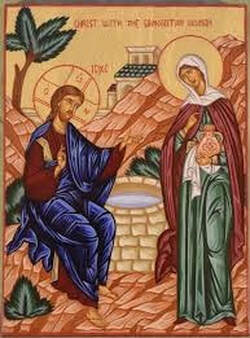
It is not surprising that the Sunday after Mid-Pentecost is devoted to The Samaritan Woman. In the Gospel (Jn. 4: 5-42) there is a vivid account of Our Lord sitting at Jacob’s Well at Sychar in Samaria..... and meeting the Samaritan Woman. To open the conversation, He asks her for a drink. She is astonished that a Jew would even speak to her and ask something of a Samaritan woman and so a conversation takes place which will change her life. Our Lord says, ‘If only you knew what God is offering and who it is saying to you, “Give me a drink”, you would have been the one to ask, and he would have given you living water.’ He then recalls His teaching given at Jewish Feast of Booths (Tabernacles) in the previous autumn, ‘The water I shall give is a spring of water, welling up for eternal life. Let anyone who is thirsty come to me .... and drink... From his heart shall flow streams of living water’ (John 7: 37-39). The Samaritan woman is so inspired by this meeting that she longs for this water, ‘Give me this living water’ , she cried. But first she had to set her life in order. Our Lord pointed out that she had had five husbands and the one with her now was not her husband. This had to be sorted before she could go forward and then she was able to become Photini, the enlightened one.
The Troparion for Mid Pentecost refers to Our Lord’s teaching at the Jewish Feast of Booths:
“In the middle point of this festive season, give my thirsty soul to drink of the waters of true worship; for You called out to all men: 'Whoever is thirsty, let him come to Me and drink!' O Christ God, Fountain of Life, glory to you.”
In fact Our Lord proclaimed, ‘Whoever drinks of the water I will give will never thirst. The water I will give for the life of the world will be water springing up within.’ St John adds, ‘He was speaking of the Spirit which those who believed in Him were to receive at Pentecost.

At this mid point of the Feast we look forward to the second great consequence of Our Lord’s Resurrection, even the outpouring of the Holy Spirit at Pentecost that we might be enlightened and empowered in our vocation. We recall that when we were received into the Holy Orthodox Church we were referred to as The Newly Enlightened......(and given a new name). We have to live up to this name as if it were Photini of Photinus. Photini and her two sons and four daughters became great ambassadors of the faith with their earthly lives ending with brutal martyrdom. Before Photini could become this devoted handmaid of God, she had to put her life in order. For us, also, we must not only thirst, but also ensure there is nothing in our lives which holds us back from full enlightenment and empowerment to live to our full Christian vocation. This, with Photini, is our preparation for Pentecost when the Holy Spirit will be poured on us again.
We note that our Lord did not compel, He never does, but He gave witness to the new life which was available and Photini responded. This new life is also available to us for “Christ is Risen!” and we are empowered by the Holy Spirit as long as our life is not a sham!

Fr David

The Sunday of the Paralysed man                                                (Acts 9: 32- 42,   John 5: 1b-15)

10/5/2020

How do you feel about the situation in which we currently find ourselves?
Listening to the news, social media and socially distanced individuals I have heard and read extremes of opinion; for some, bliss. Whilst for others, a living hell! We do not like to be victims of problems we cannot solve. Whether it is a health-related issue, a damaged relationship or a combination of complex issues of which we have no control. Few of us cope well in such situations. How would you feel if you felt despondent for your past and hopeless for your future?

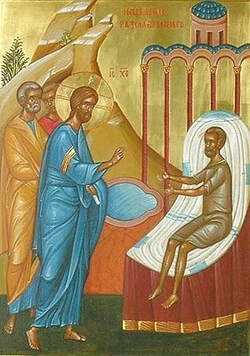
How must the paralysed man in todays gospel reading have felt? He had been paralysed for 38 years. We do not know his age but, as the length of his condition is reported, I think we can assume that this was not something he had experienced from birth. I think we can also assume that for many years this man had been coming to the pool waiting and hoping to be healed. He had seen others delivered and healed each year. Whilst he, bound by his infirmity, continued to suffer. Did this man feel dragged down by his infirmity? Did he fall back in despair and despondency? Did this man feel anger that in all the time he had been waiting to enter the pool, not a single person had shown compassion on him and helped him into the pool? Not at all!

St John Chrysostom teaches us; “Great is the profit of the divine scriptures, and all sufficient is the aid which comes from them…for the divine oracles are a treasury of all manner of medicines….in the Scriptures we may find abundant resource.      Perhaps, the most efficacious of all the remedies to be found in the Holy Scriptures is humility! Notice the humility of the paralysed man, this man wanting so much to be healed. When Christ asks him if he wants to be healed, he doesn’t just say ‘yes’, but humbly says “I have no one to put me into the pool…”. The man showed no particular evidence of faith. There is nothing to suggest he was waiting for Jesus. And yet our Lord, filled with compassion, heals him. We do not know if the paralysed man had faith or not; whether he was a good person or not. What we do know is that he demonstrated humility.

The UK has a rich history of preventing ill health and has led the way globally. Edward Jenner developed the first smallpox vaccine in 1796. The link between contaminated water and cholera was identified using data analytics in England in 1854. Penicillin was discovered by Sir Alexander Fleming in 1928. British scientists led the medical science and built the evidence base to establish the link between smoking and cancer during the 1950s. In 2007 it became illegal in England to smoke in enclosed public spaces. In 2015 we became one of the first countries to introduce a national publicly- funded vaccination programme to protect children against meningitis type B. Now we have ‘social distancing’ and self-isolation to combat Covid-19 (Coronavirus).

We all know that prevention is better than cure. And we see this principle being applied in our Lords encounter with the formerly paralysed man when they meet again in the temple.

‘14 Afterward Jesus found him in the temple, and said to him, 
“See, you have been made well. Sin no more, lest a worse thing come upon you.”

Why did Jesus say this? Was the man paralysed because of some historical sin? Probably not. Rather, I think, Jesus is pulling together the spiritual and physical. Jesus is saying that sin causes something far worse than physical paralysis. We may ask, what could possibly be worse than being physically paralysed?
Sin causes spiritual paralysis and separation from God. This is indeed worse than any physical illness. We live in a world focused primarily on physical appearance and health. A world where many are oblivious to spiritual illness. Just as we are able to feel the pain and discomfort of physical injury, we also need to learn to feel the spiritual pain of our sins. We sprain our ankle and immediately feel the pain. But what do we feel if we slander someone?

Jesus Christ, ‘Physician of soul and body’, asks each of us, weak and sinful as we are, the same question that he asked the paralysed man; “Do you want to be made well?”

If we do, then let us rise up to a life of holiness. Let us open ‘the divine oracles’ (Holy Scriptures) knowing that they are ‘a treasury of all manner of medicines’. When we are permitted let us receive Holy Communion, for the healing of body and soul. And let us not forget Confession, the forgotten medicine.

We can respond to our Lord’s question in the sure and certain knowledge that He can heal physical and spiritual illness, not only because He overcame sin, but because He also overcame the ultimate consequence of sin – death itself!

Christ is Risen!

Father Julian

SUnday of the Holy Myrrh-bearing Women                        (Acts 6: 1-7,    Mark 15: 43-16: 8)

3/5/2020

I couldn’t believe what I was seeing; I was just popping out to the recycle bin when I saw the Hearse. John (not his real name!) was dead! It appears that he fell asleep at the end of March but, because of the Coronavirus (Covid-19) situation, there had been difficulties arranging his funeral and letting others know. The only funeral car available was for Johns coffin. His widow and young son travelled with friends in a private car. Again, due to current restrictions, very few mourners where able to attend.

One cannot avoid hearing and reading stories of those being taken to hospital with the coronavirus who die alone or supported only by a PPE clad nurse. Their families never getting the opportunity to say goodbye. Not able to grieve properly.

We grieve because we loved. After the terrorist attacks on the twin towers, her majesty the Queen said, “grief is the price we pay for love”. Because loss is an inevitable aspect of all human relationships, so too is grief. We grieve naturally, just like we breathe air naturally. It affects all aspects of our existence.
Rituals that address loss have for a long time been built into the religions and cultures of the world. Whether a wailing wall, windows covered in black, ripped clothing, or overt crying, the need to grieve (to feel) and mourn (to do) is a recognized and encouraged phenomenon. The Bible says “there is a time to weep…..a time to mourn” (Ecc.Ch 3).

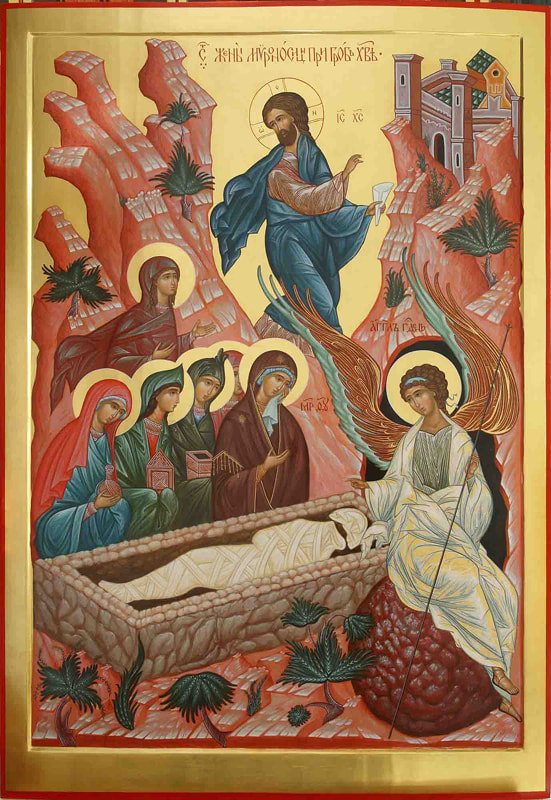
In our Gospel reading for today, Mark 15: 43-16: 8, we meet grief. There is the grief of Joseph of Arimathea and that of the Holy myrrh-bearing women. These women watched as Joseph took Christ’s body down from the cross. They followed Jesus through his passion, witnessing that he was tried and crucified. They watched as Joseph of Arimathea stepped up and gave Jesus a proper burial in his own tomb. They have seen the stone sealing the tomb. These women loved Jesus, and now they grieve for the loss of their beloved leader. All hope is lost. He is gone. And yet even in the face of hopelessness, these women act. They buy ointments that will help his body dry out as it decays, and sweet spices so that even in death, his body is honoured. Their actions show their steadfast love for Christ, that even after hope is shattered, they go the extra mile to honour Jesus. Such is their love for this dead man. In their actions, we see that the myrrh-bearers come to anoint Christ not out of a desire for any recognition or reward from Jesus, rather they are motivated by their love for Him, and the need to grieve properly.

The disciples, I am sure were also grieving. Things had not turned out the way they had expected. John was the only disciple to stand at the foot the cross, the others had run away in fear and Peter had denied Jesus three times.  They were disappointed and they were shocked. They believed that death had been the final word. They too were grieving. However, there is a very different response to the grief experienced by the myrrh-bearing women and that of the disciples.

The myrrh-bearers resisted the temptation to think only about themselves and their loss; rather they kept their focus on serving Jesus as best they could.  For them, that meant doing the sorrowful task of giving their departed Lord and friend a decent burial They found the courage and strength not to focus on themselves, but on showing love to Christ as best they could.

If we too love and serve Christ even in the midst of our most difficult struggles in life, then we also will be healed whether of our prideful selfishness or our grief. We will become more fully who our Lord wants us to be through His glorious resurrection.  Christ is Risen!

By the intercessions of the Holy Myrrh-Bearers,
O God, have mercy on us and save us.
Amen

Fr Julian