The Orthodox Parish of St Aidan & St Chad, Nottingham (EP)

Seasonal Reflection from Fr David - The Publican and the Pharisee.

21/2/2021

It is remarkable that Our Lord is never, or hardly ever, the subject of abuse. Many will disregard his teachings or fail to believe but usually they show respect. This is not surprising because Christ proclaims truth and within everyone, made in the image of God resides an understanding of truth, alongside understanding of right and wrong. As we move towards Great Lent, now only four Sundays away, it is worth emphasising that Lent is about the discovery of truth. In our self-evaluation, we discover the truth about ourselves.

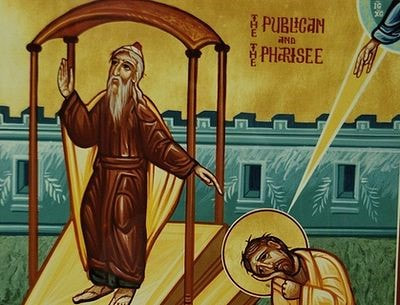
Today, as we consider the parable of the Publican and the Pharisee, there is a challenge of two questions, “Am I more like the Pharisee or am I more like the Publican?”
The key aspect of the Pharisee is that he ‘stood and prayed with himself’, glad that he was not like other men, pleased that he was good living, fasting twice each week and generous in the tithes he gave. The key aspect of the Publican was that he ‘stood afar off and would not so much as raise his eyes to heaven but beat his breast, saying, “God, be merciful to me a sinner!”        

We have to take pride in ourselves and be glad that we pray, fast and express the gifts of the Holy Spirit, ‘... patience, kindness, goodness....’ We should also be glad that we are generous to others. But we also have to seek the truth within ourselves and our behaviour to be sure that pride is not blinding us and keeping us away from change and from God. We have to be sure that there is always a call for God’s mercy - corrective loving kindness.                                                       

Are we more like the Pharisee or the Publican?  
Probably a mixture of both and our Lenten journey will help us sort this out.  Great Lent is not only of repentance as an evaluation of sinfulness but also of joy as we discover the truth within us. We seek to be master of our passions, so that we have within us the restored divine likeness in our soul. The restored divine likeness in our soul!                   
May God give His Blessing.                      
Fr David

HOMILY - SUNDAY OF THE CANAANITE WOMAN

17/2/2021

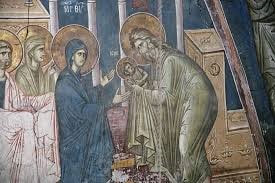
On 15th February, on the Old Calendar, we celebrate the Feast of the Meeting of Our Lord in the Temple. This is known in the West as the Presentation in the Temple. According to the Law of Moses, every firstborn male was to be presented in the Temple on the fortieth day after birth and Jesus’ parents did this in obedience as required. The Meeting, however, has a much more profound meaning; the newly born Jesus met the Elder Simeon in the Temple on this day. Simeon had been told by God that he would not see death until he had seen the Lord’s Anointed. He must have received many presented boys over the years, but he knew that this one was not only special, but very special. Indeed, he recognised him as the very one he was waiting for, the Son of God, The Lord’s Anointed. In his delight, he cried out the beautiful hymn which we sing at vespers every day; “Lord, now your servant can depart in peace for (because) my eyes have seen Your Salvation! As he held the child Jesus in his arms, he was further able to say, “(This child) is a light to enlighten the Gentiles and to be the glory of Your people Israel”.

This was a Theophany, a revealing of God. Jesus’ birth had been a rather private affair, witnessed only by Mary his mother, Joseph, probably a ‘midwife’ and some of Joseph’s, and, perhaps, Mary’s relatives. Then there were shepherds and much later, Wise Men from the East, but this for others, was a birth amongst births of no special note to the general population at the time. Now at the 40th day, in the Temple, the Theophany is more in the public eye and word of Simeon’s acclamation would have spread about. This Theophany was also witnessed by the prophetess Anna, who had been constantly at prayer in the Temple for many years. Simeon not only said, “Now mine eyes have seen Thy Salvation which Thou hast prepared before all people, a light to enlighten the Gentles and to be the glory of thy people Israel”. He proclaimed a great message for us; the child in the arms of Simeon, “a light to enlighten the Gentiles”, is for us, as we welcome the Lord Jesus into our arms, that we too maybe enlightened.

This is the truth revealed by the Canaanite woman. She, a Gentile, had heard of Jesus and now came to him to ask him to help her daughter. Initially, he challenged her, ”I have only come to the lost sheep of Israel (“to be the glory of Israel “), It is not right to give the children's food to dogs”, The Canaanite woman was not insulted by this but accepted the challenge in humility, saying with great faith, “Even the dogs eat the crumbs from the Master’s table!”. She was implying, she would willingly be a dog to feast on the crumbs which Christ might drop” To this, Our Lord acknowledged her profound faith and for the first time (according to the record) reached out to a Gentile to bring healing for her daughter and enlightenment. This is why the Meeting in the Temple supported by this encounter with the Gentile woman is, for the Orthodox Church, a much more profound understanding than simply a record of Our Lord’s, through his parents, acquiescence to the Law of Moses.

In the West, and particularly according to an old English custom, this Feast is also known as Candlemas. At the end of the Liturgy on this day, we processed around the inside of the Church with lighted candles, symbolising the Light of the World. Whilst doing this, we sang the hymn.

Blest are the pure in heart, for they shall see our God; the secret of the Lord is theirs, their soul is Christ’s abode.

It is, as in the Beatitudes, the pure in heart that see our God. With this purity to which we all aspire, we are led to understand His secret, a secret only revealed to those who truly seek Him. Then, our soul can be filled with Christ our Lord, as we hold him close to us as did the Elder Simeon on this great Feast which we celebrate today. For Christ is the Light to enlighten the Gentiles as we draw close to Him.

Fr David

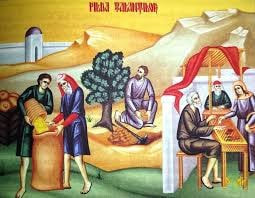
The Sunday Of The Talents        (2 Corinthians 6: 1-10 - Matthew 25: 14-30)

7/2/2021

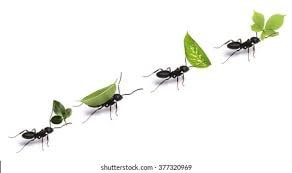
I have recently discovered an old book that I would like to commend to you. "The Insect", published in 1875, is one of four remarkable works in which the late Jules Michelet embodied the results of a loving and persevering study of Nature. These works are absolutely unique; the poetry of Science has never before illustrated on so large a scale, or with so much vividness of fancy, or in so eloquent a style. The aspects of Nature were never before examined with so strong an enthusiasm or so definite an individuality, —with so eager a desire to identify them with the feelings, hopes, and aspirations of humanity. The author approaches his subject neither as philosopher nor as poet, but yet with something of the spirit of both. His philosophy and poetry, however, both subordinate to his ardent sympathy with what he conceived to be the soul, the personality of Nature. Let me show you what I mean…

"…. the ants toiling in the sand, the quarrymen working in the sandstone. Both are of the same race; the men are ants on the surface, and the ants are men below. I admired the resemblance in their destiny, in their laborious patience, in their admirable perseverance. The sandstone is a very refractory and rebellious substance, and often splitting badly, subjects the poor workmen to severe disappointments. Those especially who are forced by a protracted winter to return to the quarry before the end of the bad weather, find the hard and yet porous blocks excessively damp and half frozen. As a result, they have numerous ill-wrought stones, and a mass of waste. However, they do not lose their courage; and without murmuring recommence their painful toil."

We really only need read the scriptures and listen to our Lord’s teachings to see how much we can learn from nature and the world around us. I think it was Sir Frances Bacon who wrote, “God has, in fact, written two books, not just one. Of course, we are all familiar with the first book he wrote, namely Scripture. But he has written a second book called creation.”

Despite being a veritable repository of wisdom, ‘The Book of Proverbs’ is not a book we tend to quote, or refer to, very often. One of my favourite passages is Proverbs 6:6 ‘Go to the ant, you sluggard! Consider her ways and be wise.’ Throughout the scriptures our Lord commands us to ‘watch’ and to ‘work’. Indeed, in our gospel reading for this Sunday we read how our Lord praises those who multiply their given talents and condemns the slothful who bury their talents. In our Epistle reading St Pauls begins “We then, as workers …” and goes on to refer to ‘labours’ and ‘patience’, as does Michelet. Michelet refers to the ‘painful toils’; St Paul speaks of ‘tribulations’ and ‘tumults’. How sad for us that we need to be directed to emulate the example of an ant, an irrational creature.

Since the leave-taking of Theophany, each of our Sunday gospel readings has been preparing us for the approach of Great Lent (15th March) and today’s gospel reading is no different. We are reminded that we have work to do! We are preparing to embark on a journey, a pilgrimage: with much work to be done as we turn (repent) and refocus on our spiritual life. We must not allow ourselves to be slothful. We can hardly find a better example of why we should not be lazy or procrastinate in prayer and spiritual work than by this example, given to us by St. Ephraim the Syrian: “Once a brother was inspired by the devil to think: ‘Give yourself rest today and tomorrow rise for vigil.’ But he answered the thought, ‘Who knows, perhaps, I will not even get up tomorrow, that is why I need to rise today.’ Before work, he was also inspired with this thought: ‘Give yourself rest today and complete your work tomorrow.’ And again, he responded, ‘No, I will complete my work today, and the Lord will take care of tomorrow.’”

St. Anthony teaches: “Before the dawn of each day, arrange your life as though it is your last day on earth and you will protect yourself from sins.”
St. Nikolai Velimirovich tells us that, “Slothfulness is one of the deadly sins, for it deadens the soul in man. A slothful soul is a nest of vices; a slothful soul is a habitation of the devil.

O Lord Almighty, Thou Who, at the same time, art all peace and all work, deliver us from destructive slothfulness and move us by Thy Holy Spirit toward all good works, for the sake of the salvation of our souls.”

Fr Julian

SUNDAY OF THE TEN LEPERS,      Luke 17: 12-19

17/1/2021

When we arrive at this particular Sunday, we know that Great Lent will soon follow, and we shall be able to more appropriately address the challenge it makes.
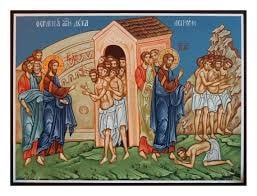
Ten Lepers came to our lord for healing and this request was granted. They went away joyfully and excited, yet only one returned to say thank you.
There was indeed need for great thankfulness. The life of a Leper in those days was challenging and full of misery. Our present “lock-downs” are devastating enough but, at least, are only temporary. For the one suffering from leprosy, it was a lifelong curse, only changed in recent times. The illness is contagious and, hence, to avoid its spread, the sufferer was separated from his/ her family, forbidden to meet with others, unable to attend Synagogue and, often, without means of livelihood. We are reminded of this in our own history when, in earlier times, Lepers could only receive communion at the Leper window without entering the Church (such a window is to be found at St Leodegarius). All were made to live away from the community in special hostels and required to ring a bell to warn every one of their presence when out and about. To be cured of the disorder of leprosy and again be admitted as a full member of community and be reunited with family and friends was an immense blessing and ground on which to be immensely thankful. No doubt all ten in the Gospel story were indeed grateful but only one retuned to Our lord to say, thank you! This story is a challenge for us, as we begin to prepare for Great Lent (still some weeks away), it is good to be aware that we too, like the nine, can, perhaps in exuberance, so easily forget to be thankful for all the blessings and gifts which God has poured upon us. It is so easy to take for granted and to forget. Lent will be a time to remedy this. We enter Great Lent, not to be miserable and chastened harshly but, among other things, to give thanks as we seek refreshment and newness of life.

A clue to thankfulness is indicated in the Epistle for the day, 1Timothy 4: 9-15:

“...be an example... in word, in conduct, in love, in spirit, in faith, in purity.... Do not neglect the gift that is in you, which was given to you........Meditate on these things; give yourself entirely to them... Continue in them, for in doing this you will save both yourself and those who hear you."! ! ! ! ! ! ! ! !

These are words of St Paul to encourage the new priest Timothy but are for all of us, in the priesthood of all believers. We hope that the Leper who returned to Our Lord became one of His disciples and learned to move into a greater fullness of life. Now that he was free of his affliction, he would indeed be able to accept and understand the life changing words given to the Apostle Timothy. Perhaps he was able to become a good witness of what life with Jesus was like, changed from outcast to inner disciple, restored. This is what we hope for ourselves and what Lent is about when we enter into what this season has to offer. Lent gives us a special set aside time to ensure that we do not neglect the gift that is in us. Great Lent leads us into greater thankfulness for what God has poured upon us and into our lives in a time for restoration. Thankfulness is the most important part of prayer; it pleases God and lifts up our own hearts. In our Christian life, our conduct, our outreaching love, the Spirit which governs our life and makes us more fully human, with firm faith and purity, in which we find ourselves. As one Father said, when visited by a group who were disappointed that he had nothing to say to them, replied “If you are not edified by my presence, you will not be edified by my words. The quality of our life is what counts and speaks more than words. Freed of limitation, as were the ten Lepers, so we, freed from whatever has been restricting us, enables us to stand thankfully in Christ and then, our presence in the world around, radiates His love and His saving grace. The society in which we live, so damaged by the Corona virus and the reaction to it, needs us, as committed, dutiful Christians, to proclaim by our witness that the foundations of this Nation are Christian, and only when its peoples return to an awareness and commitment to God the Creator Redeemer, will life be able to be on a sounder footing. Let all, like the tenth Leper, return to Christ with hearts of gratitude and thanksgiving.

The Holy Theophany Of Our Lord And Saviour Jesus Christ(Matthew 3:13-17)

10/1/2021

Well, whichever calendar you are using you will have now celebrated the feast of the Nativity and I do hope that it was truly blessed and joyful for you; although I am sure it wasn’t the celebration that you had planned!

I was delighted to receive a really interesting book as one of my Christmas presents this year. The book, written by ‘Countdown’s’ Susie Dent, is an entertaining look at Etymology (the study of the origin of words and the way in which their meanings have changed throughout history).

Have you ever come across ‘Janus words’, named after the Roman deity? Janus was traditionally depicted as having two faces which inspired several terms in English. Janus cloth, for example, is a reversible material, while a Janus lock can be fitted to either a left- or right-opening door. But perhaps the most enduring legacy of the two-faced deity is ‘Janus word': a term that has two diametrically opposed meanings. An example of a ‘Janus word’ would be ‘Dust’; to make free of dust; to sprinkle with dust. Or how about ‘Left’: went away from; remaining – I love this stuff!

Going back to Christmas and the Feast of the Nativity, from the Latin term nativus, which means "born.", this a time of year when our imaginations tend to focus on the human family, with the occasional thought for the divine Father–Son relationship that is to be made visible in the obedient, loving life of Jesus of Nazareth. Much of Christmas can go by without mentioning the Holy Spirit. But God is Trinity – Father, Son and Holy Spirit – and all of God is involved in everything God does, including the Christmas gift.

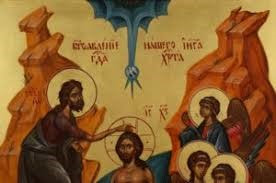
Today, we celebrate together, the Holy Theophany of Our Lord. The feast is called Theophany because at the baptism of Christ the Holy Trinity appeared clearly, to mankind, for the first time—the Father's voice is heard from Heaven, the Son of God is incarnate and standing physically in the Jordan, and the Holy Spirit descends on Him in the form of a dove.

Troparion:
Lord, when You were baptized in the Jordan, the worship of the Trinity was made manifest. For the voice of the Father gave witness to You, calling You Beloved; and the Spirit, in the form of a dove, confirmed the certainty of His words. Glory to You, Christ our God, who appeared and enlightened the world.

As Orthodox Christians when we worship Gd we are worshiping the Father, Son, and Holy Spirit—the Holy Trinity, the one God. Following the teaching of the Holy Scriptures and the Church Fathers, the Church believes that the Trinity is three divine persons (hypostases) who share one essence (ousia). All three persons of the Trinity are consubstantial with each other, that is, they are of one essence (homoousios) and coeternal. There never was a time when any of the persons of the Trinity did not exist. God is beyond and before time and yet acts within time, moving and speaking within history. Now I’m not sure if it is ‘Janus’ or paradoxical to believe thus, but that is how God has revealed himself.

The source and unity of the Holy Trinity is the Father, from whom the Son is begotten and also from whom the Spirit proceeds. Thus, the Father is both the ground of unity of the Trinity and also of distinction. To try to comprehend unbegottenness (Father), begottenness (Son), or procession (Holy Spirit) leads to insanity, says Saint Gregory the Theologian. I think C S Lewis gives us a lovely illustration of the inability of our minds to comprehend God. He writes, “Let us suppose a mystical limpet, a sage among limpets, who (rapt in vision) catches a glimpse of what Man is like. In reporting it to his disciples, who have some vision themselves (though less than he) he will have to use many negatives. He will have to tell them that Man has no shell, is not attached to a rock, is not surrounded by water. And his disciples, having a little vision of their own to help them, do get some idea of Man …. a sort of amorphous jelly (he has no shell) existing nowhere in particular (he is not attached to a rock) and never taking nourishment (there is no water to drift it towards him)”. I’m sure you get the picture.

The point I am trying to make here is that we approach God in divine mystery, approaching God apophatically. That is understanding that God's essence is unknowable, recognising the inadequacy of human language to describe God; being content to encounter God personally and yet realize the inadequacy of the human mind to comprehend Him.

And as we rejoice in the Holy Theophany let us remember that the baptism of Our Lord has been prepared since the creation of the world’
(Gen1:1_In the beginning, God created the heavens and the earth)._
God the Father, creator of all things, presides at creation. The Spirit and the Word work with him, like the two hands of the Father.
(Gen 1:2 The Spirit of God was moving over the face of the waters)
Water, connected to the Spirit, is the element indispensable for life. The Spirit’s moving over the waters is the first image of the dove spreading its wings to fertilise the waters and to call life forth from it.
(Gen 1:3 God said: “let there be light”; And there was light.
The Word of God, the creative word, orders the elements and makes them to appear out of nothing. The earth without form or content (chaos or the desert) is the image of nothingness.

In the desert, on the banks of the Jordan, the Trinity reveals itself in its work of creation. This is a new genesis for a new creation. The world, through the Spirit, is regenerated in the person of Christ, the new Adam.

Canticle Five (Forefeast of Theophany)

O Creator, who art the new Adam, Thou makest knew those born on earth, and Thou bringest to pass a strange regeneration and a wonderful restoration by fire and Spirit and water: without destruction or melting pot Thou dost renew mankind through the holy sacrament of baptism.
Through the spirit dost Thou make souls knew and through the water dost Thou sanctify our body compounded from the elements, forming man afresh as a living being. For in wiser forethought, as physician alike of bodies and of souls, with profit Thou dost minister the remedies befitting both.
Fr Julian