The Orthodox Parish of St Aidan & St Chad, Nottingham (EP)

Homily for Christmas Day 2020

25/12/2020

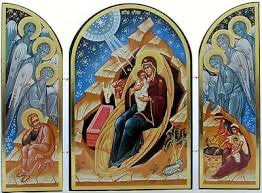
Today we remember, we witness, a most wonderful event. Two deeply, devoted, prayerful people, in a remote corner of Bethlehem, are preparing for the birth of a child, in a cave used to keep animals, because there is no room elsewhere, amongst Joseph’s relatives. 

And this is the amazing thing; a strange and wonderful mystery: the cave is Heaven, the woman, the Virgin Mary, a descendant of King David whom he describes as the Queen clothed in an embroidered mantle of gold (Psalm 44), becomes the cherubic throne, only occupied by God Himself. In the humble manger, now filled with fresh straw, has become the noble place, where reposes Christ, the uncontainable God. In the silence of the night with no-one except a few of Joseph’s relatives aware of this, is a significant event which will change the world. The world is still and silent apart from the noise of those gathered for the Great Census required of them.
But there are witnesses, shepherds who are outcasts of society, never in the Synagogue, always out in the fields watching and guarding their flocks, undoubtedly unwashed and enveloped with the scent of sheep and goats.  They are unable to be welcomed into society at large but are honoured to be the first called to see the is wonderful event.  We are privileged to stand with them, as we recall the hymn, “What can I give you, poor as I am, if I were a shepherd, I would bring a lamb, if I were a rich man, I would play my part ...
but such as I have, I give you, give you my heart”.
And what is this great event we have come to witness?  Who is this lying in the manger? None other than the Word of God who destroys the sins of mankind, who brings freedom and new life to the world and to mankind. The one who has put on the garment of our nature, born to renew the likeness that had been lost of old.  Through the Virgin Mother Mary, the Lord God, has taken on the flesh of mankind, our flesh, to fully reveal himself as our God and Saviour in order to unite us to Himself.
This Mystery, this action of God, was hidden from the leaders of Israel, who were now far astray.  If only they had understood psalm 115 which they undoubtedly read frequently: “They (who have misunderstood the nature of God) have idols of silver and gold made by human hands. They have mouths but speak not, eyes that see not, ears that hear not, noses that smell not, hands that cannot feel, feet that cannot walk...... (And).... Their makers are like them and all who rely on them are also like them!”  Eyes and ears closed!
Even we can forget that our understanding of God may be self-made, world-made, even, church-made and we are pulled away from true understanding, we too rely on ‘idols’. In this Holy Season, we pray that there may be a return of true understanding with eyes, ears and mouths, to acknowledge and praise; for God is now with us, the child in Bethlehem; more closely to us now than ever; He is on earth with us, our God and our Life.
“...such as I have, I give ... my heart.”. As we go forth, this Christmas, with the fullness of gratitude for the gift of Christ’s birth, we take the advice of St Pophyrios, “We must plug our heart into His love and be united with Him”
This is the gift of Christ’s birth; God gives us His Son and asks what in return?  LOVE.
If St Nicholas, Santa Claus, visits us this night, and we hope that he will.  We pray that our chief gift will be this:  to have eyes which see, ears that hear and understanding that is enlightened, so that “We may plug our heart into His love and be united with Him”
May you all have a most joyful and blessed Christmas for Christ is Born, glorify Him!

Fr David
Homily: Sunday of the Holy Ancestors of Christ

19/12/2020

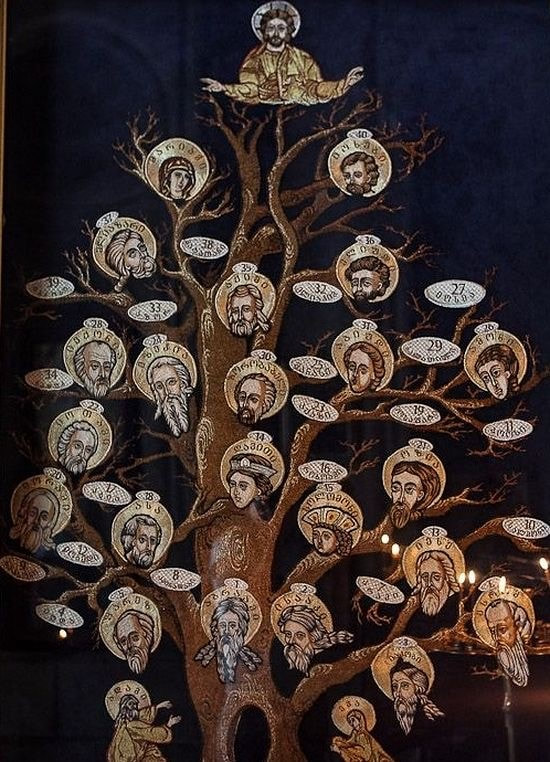
Today we celebrate the memory of the Ancestors of Christ. Christ the Word, to be the Anointed One (Messiah) in due course, was present throughout the whole of Old Testament history, and we praise Him because he has magnified His ancestors amongst all nations and commends them to us. Yet, His genealogy is not of saints, though some were. In Matthew’s gospel, which we read today, the list begins with Abraham whose great faith in God sets the wheels of Salvation in motion. He was the Great Ancestor followed by many others and yet there are some surprising inclusions. Usually, in Jewish tradition, only men were mentioned in the list of ancestors but here are three women; Tamar is included even though of a life of doubtful virtue; amongst the men, King David is one of the great ones and yet the genealogy states, ‘David your King begat Solomon by her (Bathsheba) who had been the wife of Uriah’. Yes, David had Uriah murdered so that he could take Bathsheba as his wife. A great king, yet also a murderer and an adulterer. Yes, a great prophet, a sinner, but also, he is an example of a sincere repentant sinner as his psalm 50, which we use daily, clearly acclaims. The genealogy mentions gentiles and sinners with many imperfections and yet flowing with God’s graciousness and emphasising the importance of women by their inclusion, indeed the inclusion of all
In the blessing given in this list of ancestors, Our Lord emphasises the ordinariness of His origin as well as who are special in the service of God, for the Supreme Ancestor from this lineage, is Mary, herself, His mother, His birth-giver. She, as a result of this ancestry, was the spotless handmaid, the undefiled one who could bring about God’s saving plan. From her, Christ, the Anointed One, came forth to give life to us all, bearing the name, Jesus, which means, ’O Lord save’.
Added to this genealogy of ancestors of varying fidelity, Our Lord is born in a stable, laid in a manger full of hay, surrounded by sheep, in as lowly surroundings as possible. By His very birth and His ancestry, He demonstrates the graciousness of God who accepts all in His love and with utmost desire that we all return to Him and accept the sonship and daughterhood which He so freely gives.
What a sadness that our nation has fallen so far away from its Christian foundations and stands, so much, in denial of God’s benevolence, without recognising that there is only fullness of Life in God our creator. With this also, is the strange denial of death, not only because it is not wanted but there is also a denial that anyone will return to, and receive God’s loving provisions, even when earthly life comes to an end. I wonder if this is the Sin against the Holy Spirit, which Our Lord mentions as unforgivable; there is certainly a denial that it is in the Holy Spirit that we live and move and have our being and a wilful hardness of heart to accept His existence. It seems the established Church in this Land, often plays into this; the funeral service is so often a celebration of the deceased’s life rather than a prayerful commendation of him/her as one who has fallen short, and who needs the mercy and forgiveness of God and is commended into His loving care. Fortunately, in our Orthodox Tradition, we only mention aspects of the person’s earthly life in the funeral oration whilst the whole of the funeral service is an appeal for God’s mercy and a commendation into a life beyond, “Give rest, O Christ, to the soul of thy servants with the saints, where sorrow and pain are no more, neither sighing, but life everlasting.” (Kontakion of the Dead).
So here is the good news, the Gospel for today. Whatever our origins, the origins of our family and the fidelity of its forebears, we have been enrolled into the gracious salvation of God through our Lord Jesus the Christ, the one who saves, the Anointed One. We are within the Church where men and women are equal, where gentiles are welcome, where there is no sin which separates us from God (unless there is sin against the Holy Spirit, a denial of the divine activity of the Spirit by wilful hardness of heart), and if faithful, we have a guaranteed place in Paradise. And so, we go forward, in our preparation for the Feast of the Nativity, standing with the Ancestors of Christ, standing with His Holy Mother and Joseph to whom she is betrothed (married) and standing with great blessing.
Through faith, You have justified Your Ancestors, O Christ our God; and through them, you have espoused in advance the Church set apart from the Gentiles. The saints rejoice in glory because, from the seed of these Ancestors, has come froth the glorious fruit, who gave you birth without seed. Through their intercessions, O Christ God, save our souls! (Troparion of the Ancestors)
Fr David

Homily on St Nicholas (Luke 13:10-17)

6/12/2020

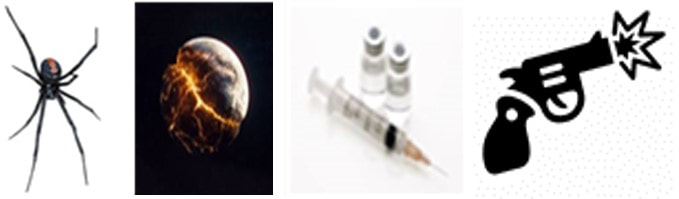
​Do you watch ‘Only Connect”?
Can you work out what the connection is between these four clues and why?

The answer is Superheroes.

​All of these images portray the reason why specific comic book characters became their superhero personae. Peter Parker (Spiderman) was bitten by a radioactive spider, Clark Kent (Superman) was from the planet Krypton, Steve Rogers (Captain America) was enhanced to the peak of human ability by an experimental serum and Bruce Wayne (Batman) swore vengeance against criminals after witnessing the murder of his parents).
​
If we look at the concept of a ‘Superhero’ we are likely to conclude that this is any kind of fantasy/science fiction crime-fighting character, often with supernatural powers or equipment and most often found in popular children's and fantasy literature. However, if we look at the concept of a ‘Hero’ we are likely to deduce that these are real or mythical person of great bravery who carrys out extraordinary deeds. Our Christian heritage is filled with Superhero-hero’s. ‘Superheroes’ by virtue of possessing supernatural powers and ‘Heroes’ because they are real and not fantasy characters. All who exhibit extraordinary courage.

The root of the word ‘courage’ is ‘cor’—the Latin word for heart. today, courage is synonymous with being heroic. However, in one of its earliest forms, the word courage had a very different definition to todays. Courage originally meant “To speak one’s mind by telling all one’s heart.”

I think it is fair to say that we have pretty much lost touch with the idea that speaking honestly and openly about who we are, about what we’re feeling, and about our experiences (good and bad) is the definition of courage. We often see ‘Heroics’ as putting one’s life on the line, but I want to suggest that being courageous and heroic can also be about putting our vulnerability on the line. In today’s world, that can be pretty extraordinary.

In our gospel reading, Luke 13: 10-17, we witness heroism; we witness that of the ‘woman who had a spirit of infirmity for eighteen years’ (v11). Vulnerable, bent over and could ‘in no way raise herself up (v11} yet this woman still went to the synagogue on the sabbath, her bodily infirmities did not prevent her from participating in public worship – Heroic!

We witness too the Heroism of our Lord. Having spoken out previously about the hypocrisy of the Jewish authorities Jesus is vulnerable and yet he continues to attend and teach in the synagogue on the sabbath. Again, he challenges the indignant Jewish authorities and calls the ‘ruler’ of the synagogue a hypocrite (v15). Our Lord sees that it is not only the woman who has the infirmity. Those who are challenging Jesus are under a spirit of infirmity; they have distorted hearts; they are unable to raise themselves up to God and heaven.

We should note that our Lord, in his compassion, offers healing to the woman without it being sought or requested (v12). Although she could in no way raise herself up, Christ could lift her up and enable her to lift up herself. She that had been bent was immediately made straight (v13).

So often we fall and judge others only according to outward appearance. Not so our Lord; he knew fully the enmity that was felt both to him and his gospel! – And His adversaries knew they were wrong, ‘And when He said these things, all His adversaries were put to shame’ (v17). The shame of his adversaries was the joy of his followers ‘and all the multitude rejoiced for all the glorious things that were done by Him’. They rejoiced in his Heroism.

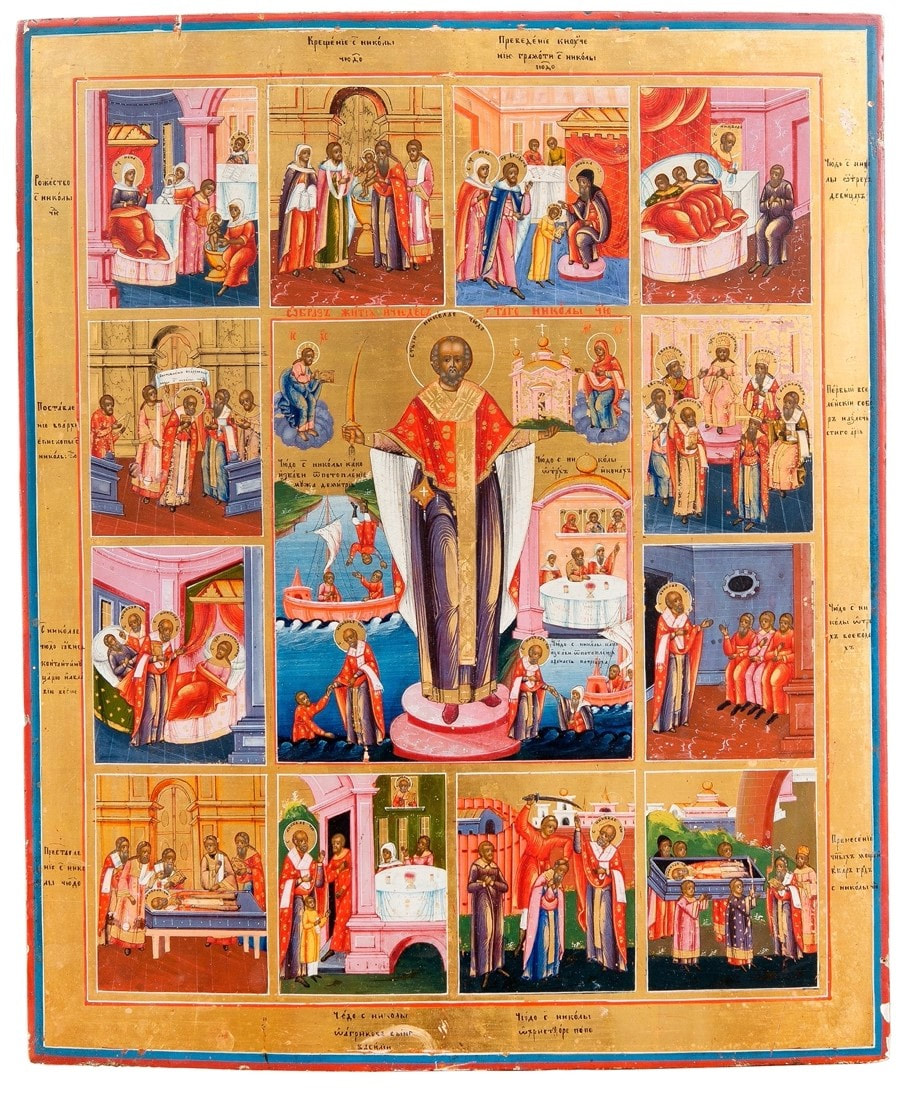
 Today we celebrate the feast of St Nicholas. As Bishop of Myra in Lycia, Nicholas was imprisoned for his faith under the Roman emperor Diocletian but freed by his successor Constantine. It is reported that on his way to the council of Nicea he performed a miracle, bring back to life three murdered boys. Further reported miracles involve him appearing in a vision or a dream to free three condemned man or to save three storm-bound sailors. And of course, his most famous act was giving three sisters dowries, as they came of age, to save them from prostitution or slavery.

St Nicholas was and is still heralded by many as a healer of the sick, the liberator of captives, the treasure of the poor, the consoler of the afflicted and a guide to travellers. The feast of St Nicholas is surrounded with a special solemnity and his life with Heroism, He is truly one of the truer Heroes of the Orthodox faith!

23rd Sunday after Pentecost: Gospel, Luke 10: 25-37 Beginning of the Nativity Fast

14/11/2020

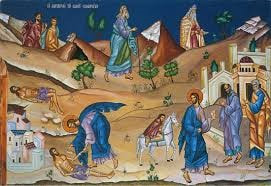
In today’s Gospel, the familiar parable of the Good Samaritan, we read of a lawyer who stood up to test Jesus. His question was this, “What shall I do to inherit eternal life?” This is a question for us also. What must we do?
The lawyer’s understanding was this, “You shall love the Lord your God with all your heart, with all your soul, with all your strength, and with all your mind, (and your neighbour as yourself)” (Luke 10: 25 ff).
Metropolitan Anthony of blessed memory used to quote a father who said that if all scripture was lost, it could be rewritten, be written again, by observing the lives of Christians. Their lives would display Christlikeness and all His teachings would be evident in their devotion to God and their love and care for neighbours.
I wonder how true this would be if we were the ones to be so observed, and through the example of our lives would, for example, the teachings of the Sermon the Mount and the teaching of the Good Samaritan be discernible. The lawyers response to Jesus is, of course, a summary of the Ten Commandments of Old Testament times. In our lives, is it true and evident that we have loved the Lord our God with all our heart, with all our soul, with all our mind and with all our strength; that we have never made for ourselves an idol to replace God; that we have never dishonoured Him; that we have remembered the Lord’s day to keep it holy; that we have honoured our father and our mother; that we have committed no murder; that we have not committed adultery; that we have not stolen; that we have not been a false witness; that we have not coveted anything which belongs to our neighbour? As we consider this, we have to remember Our Lord’s extension of these commands; that cursing a brother is a form of murder, that looking on anyone with lust is adultery, and so on. (Matthew 5: 21-48)
For us Christians it is the Beatitudes which are to be our guide rather than the ten commandments only. It is the Beatitudes Which give the standard with which we assess our lives. Am I poor in Spirit, knowing my need of God, do I mourn for my sins and wrongdoings, am I meek and lowly of heart like Jesus, do I hunger and thirst for righteousness, am I merciful, pure in heart, a peacemaker, do I rejoice and be glad when men persecute me and say all manner of things against me for Christ’s stake? Do I rejoice greatly when I think of my reward in heaven for being faithful to Christ?
In these Commandments and Beatitude’s is the Good News! The teachings of Christ are not to point out that we have failed - we know that when we reflect on our lives - the Good News, written in the Commandments and Beatitudes is to tell us who we really are; sons and daughters of God, made in His image, being transformed into His likeness. The Good News is not to condemn us but to help us to know who we are and to become what we are meant to be. These Commandments and Beatitudes are guidelines to enable us to live a better fuller life. The young lawyer had lived within the Commandments and now stood before Christ to be lead on a new path. When he asked, ‘but who is my neighbour’, Jesus gave the example of the Good Samaritan and then said, ‘Go and do likewise’. We hope the young lawyer was able to respond.
Our Lord says the same to us, ‘Go and do likewise’. The challenge is great, and we should heed it so that our lives are also changed. As we enter into the Nativity Fast, we might think again of our commitment to the one born into our midst, whose birth we celebrate at Christmas. We might assess again what it means to be made in the image of God and now in the process of being transformed into His likeness, the likeness of Christ. God became man that we might become like God in the likeness of Christ whose life we share through our baptism. The imperative is there, the guidelines are revealed, may we, with the young lawyer, be transformed likewise.

Amen!

Fr David

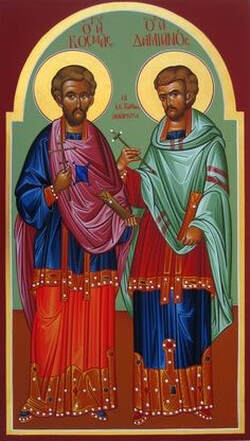
Holy Wonderworkers and Unmercenaries Cosmas & Damian of Mesopotamia & Their Mother, St Theodota

31/10/2020

The following are statements are exactly as typed by medical secretaries:

Patient has chest pain if she lies on her left side for over a year.
On the second day the knee was better and on the third day it disappeared.
The patient has been depressed since she began seeing me in 1993.
Discharge status: Alive, but without my permission.
Patient had waffles for breakfast and anorexia for lunch.
Skin: somewhat pale, but present.
Patient has two teenage children, but no other abnormalities.
The patient refused autopsy.
The patient has no previous history of suicides.

I think it was Paul Meyendorff who wisely said, “Healing is too important to be left solely to the medical profession”.

his Sunday (1st Nov) we remember Sts Cosmas & Damian together with St Theodota, their mother. The Holy Wonderworkers and Unmercenaries, and their mother, were natives of Mesopotamia. Their pagan father died while they were still quite small children and so the brothers were raised by their mother in Christian piety. Through her own example, and by reading holy books to them, Saint Theodota preserved her children in purity of life according to the command of the Lord, and Cosmas and Damian grew up into righteous and virtuous men.

Trained and skilled as physicians, they received from the Holy Spirit the gift of healing people’s illnesses of body and soul by the power of prayer. They even treated animals. With fervent love for both God and neighbour, they never took payment for their services. They strictly observed the command of our Lord Jesus Christ, “Freely have you received, freely give.” (Mt. 10:8). The fame of Saints Cosmas and Damian spread throughout all the surrounding region, and people called them unmercenary physicians. 

Once, the saints were summoned to a grievously ill woman named Palladia, whom all the doctors had refused to treat because of her seemingly hopeless condition. Through faith and through the fervent prayer of the holy brothers, the Lord healed the deadly disease and Palladia got up from her bed perfectly healthy, giving praise to God. In gratitude for being healed and wishing to give them a small gift, Palladia went quietly to Damian. She presented him with three eggs and said, “Take this small gift in the Name of the Holy Life-Creating Trinity, the Father, Son, and Holy Spirit.” Hearing the Name of the Holy Trinity, the unmercenary one did not dare to refuse. 

When Saint Cosmas learned what had happened, he became saddened, thinking that his brother had broken their strict vow. On his deathbed he gave instructions that his brother should not be buried beside him. Saint Damian died shortly afterward, and everyone wondered where Saint Damian’s grave should be. But through the will of God a miracle occurred. A camel, which the saints had treated for its wildness, spoke with a human voice saying that they should have no doubts about whether to place Damian beside Cosmas, because Damian did not accept the eggs from the woman as payment, but out of respect for the Name of God. The venerable relics of the holy brothers were buried together.

I am sure that many, if not all of us are familiar with our Gospel reading, Luke 16: 19-3. And I am sure that many of us understand this parable deals with the subject of wealth, both material and spiritual. I also believe that it also deals not only with WEALTH but material and spiritual HEALTH.

Firstly, we have the physical condition of Lazarus; Hungry, malnourished, full of sores which are licked by dogs. Then we have the spiritual condition of the rich man. Despite the torments he is suffering his heart is untouched; he still sees Lazarus as a servant existing for the sake of his own comfort. Despite his riches, his fine linen and sumptuous life the rich man is unnamed. Perhaps indicating that he is ultimately unhealed, lost and forgotten!

Meyendorff was so right when he says, “Healing is too important to be left solely to the medical profession”. However, that is exactly what our modern society is doing; the sick or herded into hospitals pumped full of wondrous drugs hooked up to an ever-increasing array of machines. Today we are witnessing the sick being removed from their homes, separated from their families and loved ones. Hospitals nursing homes and care facilities not only providing medical care, but they also insulate the rest of us from having to come face to face with pain suffering death and our own mortality. Society has chosen to leave healing to the medical profession. Our doctors and our hospitals have all the knowledge and technology, and we are perfectly happy to leave everything in their hands.

True healing is both physical and spiritual and can only be given by Christ the physician of our souls and bodies. The healing ministry of Christ is a primary task of the church we are Christ's presence in the world and we, as the church, are charged with bringing healing to those around us. There is no rite or sacrament which does not contain some reference to healing, our Sunday gospel reading's and the liturgical prayers frequently contain some reference to healing.

St James tells us_, "_ Is anyone among you sick? Let him call for the elders of the church, and let them pray over him, anointing him with oil in the name of the Lord. 15 And the prayer of faith will save the sick, and the Lord will raise him up. And if he has committed sins, he will be forgiven.” (James 5:14-15)

Every aspect of church life involves an element of healing, in fact, it is the core of the churches mission. We each have a role to play in bringing heath and healing to others, whether by our witness, by listening, by the prayer we offer, by anointing……
And so, lets us like the Holy Wonderworkers and Unmercenaries Cosmas & Damian observe our Lord’s command, “Freely have you received, freely give.”